
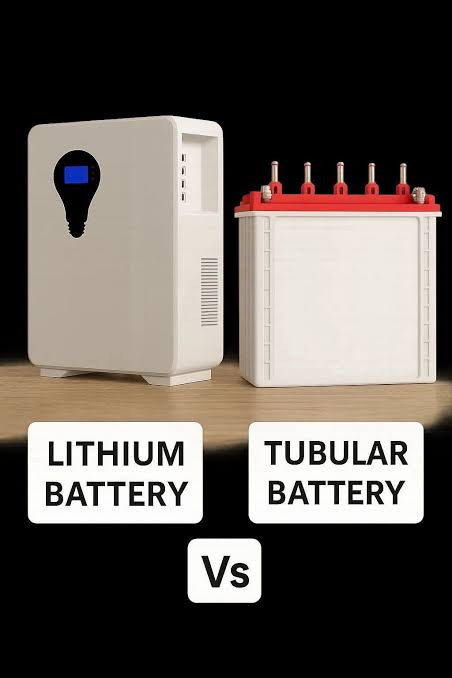
Lithium Battery vs Tubular Battery: Which Is Better for Solar Systems in Nigeria?
Choosing the right battery is one of the most important decisions when designing a solar power or inverter system.
Solar panels generate electricity during the day, but your battery determines how much of that energy can be stored and how reliably it can be used at night or during power outages.
Two battery technologies commonly considered for solar installations are lithium batteries, particularly LiFePO4 (Lithium Iron Phosphate), and tubular lead-acid batteries.
Both technologies can provide reliable energy storage when correctly sized and installed. However, they differ considerably in usable capacity, charging performance, maintenance requirements, cycle life, weight, efficiency and long-term cost.
So, which is better: lithium or tubular battery?
For most modern solar systems that require frequent daily cycling, lithium—especially LiFePO4—is generally the stronger long-term option. However, tubular batteries can still make sense when the primary objective is reducing the initial investment.
Let's examine the differences.
What Is a Lithium Battery?
A lithium battery used in modern solar installations is commonly based on Lithium Iron Phosphate (LiFePO4) chemistry.
LiFePO4 batteries are designed for repeated charging and discharging and are widely used in residential, commercial and off-grid energy-storage applications.
A major feature is the Battery Management System (BMS) found in many modern lithium battery packs. The BMS monitors parameters such as voltage, current and temperature and provides protection functions appropriate to the battery design.
Lithium batteries also typically allow a greater proportion of their rated energy to be used compared with conventional lead-acid batteries.
For example, a properly specified 10 kWh LiFePO4 battery may provide around 8 kWh of usable energy at an 80% depth of discharge, subject to the manufacturer's specifications and operating conditions.
What Is a Tubular Battery?
A tubular battery is a type of lead-acid battery designed for deep-cycle applications.
It uses tubular positive plates that provide better durability for repeated charging and discharging than conventional automotive batteries.
Tubular batteries have been popular in Nigeria for many years because they are relatively affordable, widely available and familiar to technicians.
However, flooded tubular batteries generally require periodic maintenance, including checking electrolyte levels and topping up with distilled water according to the manufacturer's instructions.
They are also considerably heavier than lithium batteries and normally should not be discharged as deeply or as frequently if long service life is the goal.
1. Battery Lifespan
One of the biggest differences between lithium and tubular batteries is cycle life.
A battery cycle represents a charge and discharge process. Batteries that are repeatedly cycled every day need a chemistry capable of handling many cycles.
Quality LiFePO4 batteries can commonly be rated for thousands of cycles, with many products specified around 3,000–6,000 cycles depending on operating conditions and the manufacturer's test methodology.
Tubular lead-acid batteries generally have significantly fewer cycles, particularly when frequently subjected to deep discharge.
Field performance in Nigeria can also differ from laboratory ratings because of ambient temperature, charging quality, depth of discharge, maintenance and installation conditions.
Winner: Lithium
For applications involving regular daily charging and discharging, lithium generally has a major advantage.
2. Depth of Discharge
Depth of Discharge (DoD) refers to how much of a battery's stored energy is used before it is recharged.
This is extremely important when comparing batteries.
A tubular battery is generally operated at a shallower DoD if you want to maximize its lifespan. A commonly used planning figure is around 50% usable capacity, although the exact recommendation depends on the battery manufacturer and application.
LiFePO4 batteries can generally operate at a significantly deeper DoD, often around 80% or more, according to the battery manufacturer's specifications.
Example
Suppose you have:
10 kWh tubular battery bank
At 50% usable capacity:
10 kWh × 50% = approximately 5 kWh usable
Now compare that with:
10 kWh LiFePO4 battery
At 80% usable capacity:
10 kWh × 80% = approximately 8 kWh usable
Therefore, two batteries with the same nominal capacity can provide significantly different amounts of practical usable energy.
Winner: Lithium
3. Charging Speed
Charging speed becomes particularly important in Nigeria.
Solar systems have a limited daily window in which the PV array can generate substantial energy.
If a battery charges slowly, there may be occasions when the available solar energy cannot be fully utilized before the sun sets.
Lithium batteries generally accept higher charging currents than conventional lead-acid batteries, subject to the manufacturer's specifications.
This makes lithium particularly attractive for systems where the battery needs to recharge quickly between power outages or during limited solar-generation periods.
Winner: Lithium
4. Energy Efficiency
Battery efficiency affects how much energy you actually get back after putting energy into the battery.
LiFePO4 systems generally have higher charge/discharge efficiency than lead-acid batteries. Typical published figures often place lithium around the mid-to-high 90% range, while lead-acid systems are generally lower.
This means less solar energy is lost during the storage process.
For a large commercial solar installation, even a few percentage points of efficiency can become significant over thousands of operating cycles.
Winner: Lithium
5. Maintenance Requirements
This is another major difference.
Flooded tubular batteries require periodic attention.
Depending on the manufacturer's design and operating conditions, maintenance can include:
Checking electrolyte levels
Adding distilled water
Cleaning terminals
Checking connections
Monitoring battery voltage
Ensuring proper ventilation
Inspecting for corrosion
Lithium batteries are generally sealed and require far less routine maintenance.
However, maintenance-free does not mean installation-free. Correct charging parameters, protection, cable sizing, ventilation/thermal considerations and BMS compatibility remain important.
Winner: Lithium
6. Weight and Installation
Lead-acid batteries contain substantial amounts of lead and are therefore heavy.
A large tubular battery bank can require:
Strong battery racks
More installation space
Additional handling during installation
Greater structural consideration
Lithium batteries can provide substantial usable energy with considerably less weight and footprint.
This is particularly useful for homes and businesses where installation space is limited.
Winner: Lithium
7. Safety Considerations
Battery safety should never be overlooked.
Flooded lead-acid batteries can produce hydrogen gas during charging and therefore require appropriate ventilation and installation practices.
LiFePO4 batteries are generally regarded as one of the more stable lithium chemistries for stationary storage, but they are not risk-free. Proper BMS protection, certified equipment, correct charging parameters, temperature management and professional installation remain essential.
The battery should also be compatible with the inverter and configured according to the manufacturer's specifications.
Winner: Depends on installation quality
The safest battery is not simply the battery with the best chemistry—it is a correctly specified, genuine battery installed and protected correctly.
8. Initial Purchase Cost
This is where tubular batteries have a major advantage.
A tubular battery system can require less money upfront than an equivalent lithium system.
For customers working with a limited budget, this can make tubular technology attractive.
However, purchase price should not be confused with total cost of ownership.
If a battery is replaced several times during the lifetime of the solar system, the total expenditure can eventually exceed the initial savings.
Life-cycle studies comparing the two technologies have found that lithium can offer lower storage costs over longer operating periods despite its higher initial purchase price.
Winner: Tubular for initial cost
Winner: Lithium for long-term value in many applications
9. Which Battery Is Better for Frequent Power Outages?
This is particularly relevant in Nigeria.
If your battery is being charged and discharged almost every day because of:
Grid outages
High electricity demand
Generator replacement
Off-grid operation
Commercial operations
Home-office use
Solar-only operation
then cycle life becomes extremely important.
In these situations, LiFePO4 is generally the more suitable technology because it is designed for frequent cycling and offers significantly higher cycle life than conventional lead-acid technologies.
10. Which Battery Is Better for a Small Budget?
If your immediate priority is minimizing the upfront cost, a tubular battery can still be considered.
However, the system should be designed correctly.
Buying a cheap battery that is consistently over-discharged is not a good investment.
For example, if a customer requires 10 kWh of usable energy, installing a battery bank with only 10 kWh nominal lead-acid capacity may not provide the expected backup because only a portion of the rated capacity should routinely be used.
This is why battery sizing should be based on usable energy, not simply the battery's advertised Ah rating.
Lithium vs Tubular: Which One Should You Choose?
There is no single battery that is perfect for every application.
Choose Lithium LiFePO4 if you want:
✅ Long service life
✅ Frequent daily cycling
✅ Faster charging
✅ Higher usable capacity
✅ Lower maintenance
✅ Higher efficiency
✅ Reduced installation footprint
✅ Better long-term value
✅ Modern inverter/BMS communication
✅ Reliable solar energy storage
Consider Tubular if you prioritize:
✅ Lower initial investment
✅ Simple and widely available technology
✅ A lower-cycle application
✅ An application where periodic maintenance is acceptable
✅ Existing inverter infrastructure designed for lead-acid batteries
Why We Recommend LiFePO4 for Many Modern Solar Systems
At Ytech Engineering Services Limited, we don't believe battery selection should be based solely on the cheapest quotation.
The correct battery depends on the customer's:
Daily energy consumption
Peak load
Required backup duration
Solar PV capacity
Inverter capacity
Charging current
Battery voltage
Installation environment
Expected daily cycling
Budget
Long-term energy requirements
For a customer who needs reliable daily backup and expects the system to operate for many years, investing in a quality LiFePO4 battery can make more technical and financial sense than repeatedly replacing lead-acid batteries.
Don't Compare Batteries by Ah Alone
One of the biggest mistakes customers make is comparing batteries only by their Amp-hour (Ah) rating.
For example:
12V × 200Ah = 2.4 kWh nominal energy
But nominal energy isn't necessarily the same as usable energy.
A battery's practical performance depends on:
Voltage × Capacity × Usable DoD × Efficiency
This is why a professional solar designer should evaluate the complete battery specification rather than simply asking:
"How many Ah is the battery?"
At Ytech Engineering Services Limited, we size battery banks based on the customer's actual load profile and required backup duration.
What About Battery Price?
Battery prices in Nigeria can change significantly based on:
Battery chemistry
Brand
Capacity
Voltage
Cell quality
BMS specification
Warranty
Exchange rate
Importation costs
Distributor
Installation requirements
Therefore, the cheapest battery quotation isn't necessarily the best value.
A professional comparison should consider:
Initial Cost + Installation + Maintenance + Replacement + Energy Efficiency + Expected Service Life
rather than purchase price alone.
Final Verdict: Lithium vs Tubular Battery
So, which is better—lithium or tubular battery?
For most modern residential, commercial and off-grid solar systems requiring frequent cycling, LiFePO4 lithium batteries are generally the better long-term choice.
They offer:
Longer cycle life + deeper usable capacity + faster charging + higher efficiency + lower maintenance.
Tubular batteries remain relevant because they offer a lower entry price and are widely available. They can be appropriate for certain applications, particularly where initial capital expenditure is the dominant consideration and battery cycling is relatively modest.
The most important thing is to choose the battery based on the application—not simply the price.
Need Help Choosing the Right Solar Battery?
Choosing between lithium and tubular batteries can be confusing, especially when comparing different battery capacities, brands and inverter systems.
Ytech Engineering Services Limited provides professional solar power system design, installation, battery sizing, inverter installation, electrical services, maintenance and energy solutions.
Whether you need a small residential backup system or a large commercial solar installation, our engineering approach focuses on designing a system around your actual energy requirements.
Don't just buy a battery. Design the right energy-storage system.
Ytech Engineering Services Limited — Engineering Reliable Power Solutions for Homes and Businesses.
Frequently Asked Questions
Is lithium battery better than tubular battery?
For most applications requiring frequent daily cycling, lithium LiFePO4 offers advantages in cycle life, usable capacity, charging speed, efficiency and maintenance. Tubular batteries remain attractive when upfront cost is the primary concern.
How long does a lithium solar battery last?
Quality LiFePO4 batteries are commonly rated for several thousand cycles. Actual service life depends on depth of discharge, temperature, charging parameters, usage pattern and battery quality. Published Nigerian-focused sources commonly report multi-year service lives of roughly 8–15 years for LiFePO4 under appropriate conditions.
How long does a tubular battery last?
Tubular battery lifespan varies substantially depending on cycling, maintenance, temperature, charging and battery quality. Nigerian-focused sources commonly report approximately 2–5 years, but actual field performance can be shorter or longer.
Can I replace my tubular batteries with lithium?
Possibly. The inverter must be compatible with the lithium battery's voltage, charging requirements and communication/protection requirements. Some systems may require inverter configuration changes or replacement.
Can lithium batteries be used with solar panels?
Yes. LiFePO4 batteries are widely used for solar energy storage. However, the battery, inverter/charger and PV system must be correctly sized and configured.
Are tubular batteries still good for solar?
Yes. Tubular batteries remain a viable technology for solar and inverter systems when correctly sized, charged, maintained and operated within their recommended limits.
Which battery gives longer backup?
Backup duration depends primarily on usable battery capacity and the connected load, not simply battery chemistry. A properly sized lithium battery can provide more usable energy from the same nominal capacity than a comparable lead-acid battery operated at a shallower DoD.
Is lithium worth the extra money?
For systems that cycle frequently, lithium can be worth the additional upfront investment because of its longer cycle life, higher usable capacity, lower maintenance and greater efficiency. However, a proper life-cycle cost analysis should be performed for each project.